
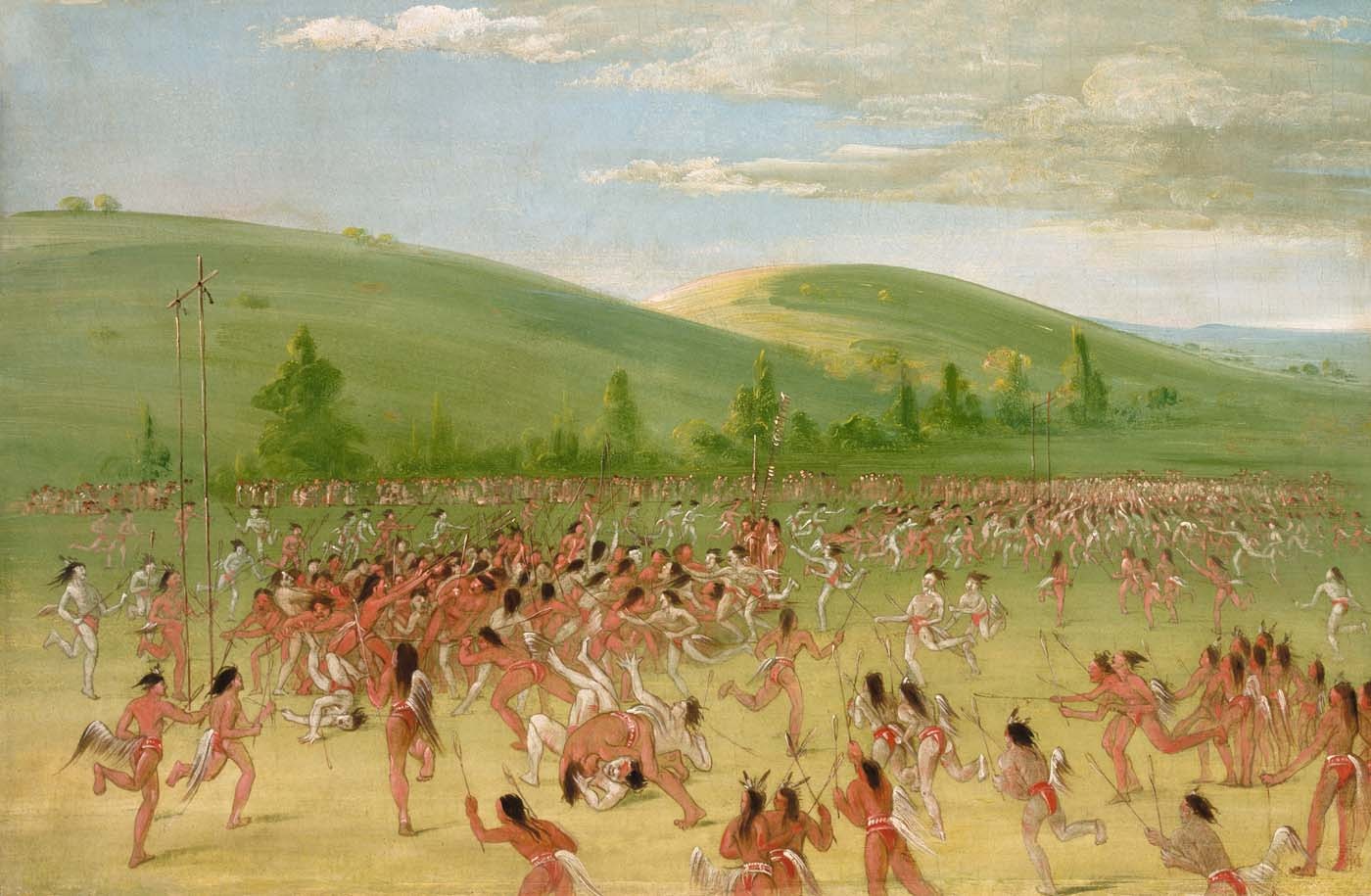
Long before modern lacrosse, nations across eastern North America played a fast, fierce ball game with netted sticks. In 1907, the Smithsonian’s Handbook of American Indians called it “the favorite athletic game of all the eastern tribes from Hudson bay to the Gulf.” Southern nations such as the Choctaw played with a pair of sticks. Canada later adopted the game and named it lacrosse.
The painter George Catlin recorded the Choctaw game. His 1848 catalogue lists a night-long “Ball-play Dance” before a match, with men and women dancing at their goals, and then the game itself: “each has two sticks with a web at their ends, in which they catch the ball and throw it.” He also painted the famous player Tul-lock-chish-ko with his sticks in hand.
The Choctaw call the game ishtaboli, and it is also known as the “little brother of war,” because communities sometimes settled disputes on the ball field instead of the battlefield. The Choctaw carried the game through the forced removal from their Mississippi homeland in the 1830s and kept it alive in their new home in what is now Oklahoma. Today teams still take the field here on the Choctaw Nation’s reservation.
A large print of this Catlin painting hangs on the cabin wall at Hidden Pond Lodge. If you’d like to see Choctaw culture firsthand, the Choctaw Nation’s events calendar, including its Labor Day Festival at the capitol grounds in Tuskahoma, is the place to look for games. Please be a respectful guest, and ask before you take photos.
Sources: Catlin, Descriptive Catalogue (1848), pp. 31, 40; Hodge, Handbook, vol. 1, “Ball play,” p. 127; Biskinik (Choctaw Nation): “Little brother of war: Ishtaboli lives on”; choctawnation.com/about/reservation/.